How Designers Choose Sustainable Materials: A Beginner’s Guide
For designers, materials shape almost everything. They affect durability, cost, appearance, maintenance, repairability, user experience, and environmental impact. Yet many designers were never properly taught how to evaluate materials beyond colour, finish, and performance.
That is where material literacy comes in.
Material literacy is the ability to understand what a material is, where it comes from, how it is made, how it performs, and what happens to it at the end of its life.
It helps designers move beyond trend-led or purely aesthetic choices towards making decisions that take into account a material’s full life cycle. This gives designers more confidence and more clarity in their decision-making.

What makes a material more sustainable?
There is rarely one perfect material for all scenarios; instead, it is worth asking:
Is this material the right choice for this application?
A more circular and sustainable material usually performs well across these categories:
It uses lower-impact and responsibly sourced production inputs
It is durable enough for the intended use
It can be repaired, reused, or remanufactured
It can be separated or recycled more easily
It avoids unnecessary toxicity
It fits the lifespan of the product or interior
It can be sourced in a way that makes sense geographically and commercially

5 questions to ask before specifying a material
1. What Is It Made From?
Start by understanding the raw materials that make up the material you are considering specifying.
Is it made from renewable resources that are grown, such as plant-based fibres or timber? Is it derived from mineral resources that are mined, such as metals, glass, or stone? Or is it produced from fossil-based inputs, such as plastics and synthetic polymers?
Understanding the origin of a material helps designers think more clearly about its wider impact. It also provides insight into how the material might behave within a circular system. Whether it can be reused, recycled, composted, or recovered at the end of its life.
By identifying where a material comes from, designers can start to evaluate not just its performance, but also how responsibly it can be sourced and how long it can remain in use.

2. How Is It Manufactured?
Understanding how a material is manufactured is just as important as knowing what it is made from. The production process can significantly influence the environmental impact of a material.
Some materials require high levels of energy, heat, or chemical treatments during manufacturing. Others may involve coatings, adhesives, or composite layers that improve performance but make the material harder to repair, separate, or recycle later.
By looking at how a material is produced, designers can begin to understand the resources, energy, and processes involved in bringing it to market. This knowledge helps identify materials that balance performance with lower-impact manufacturing and that are more likely to fit within a circular design approach.
3. How Long Does It Need to Last?
A material should always be considered in relation to how long it is expected to perform. Not every design application requires the same lifespan, and choosing materials that match the intended duration of use is an important part of responsible specification.
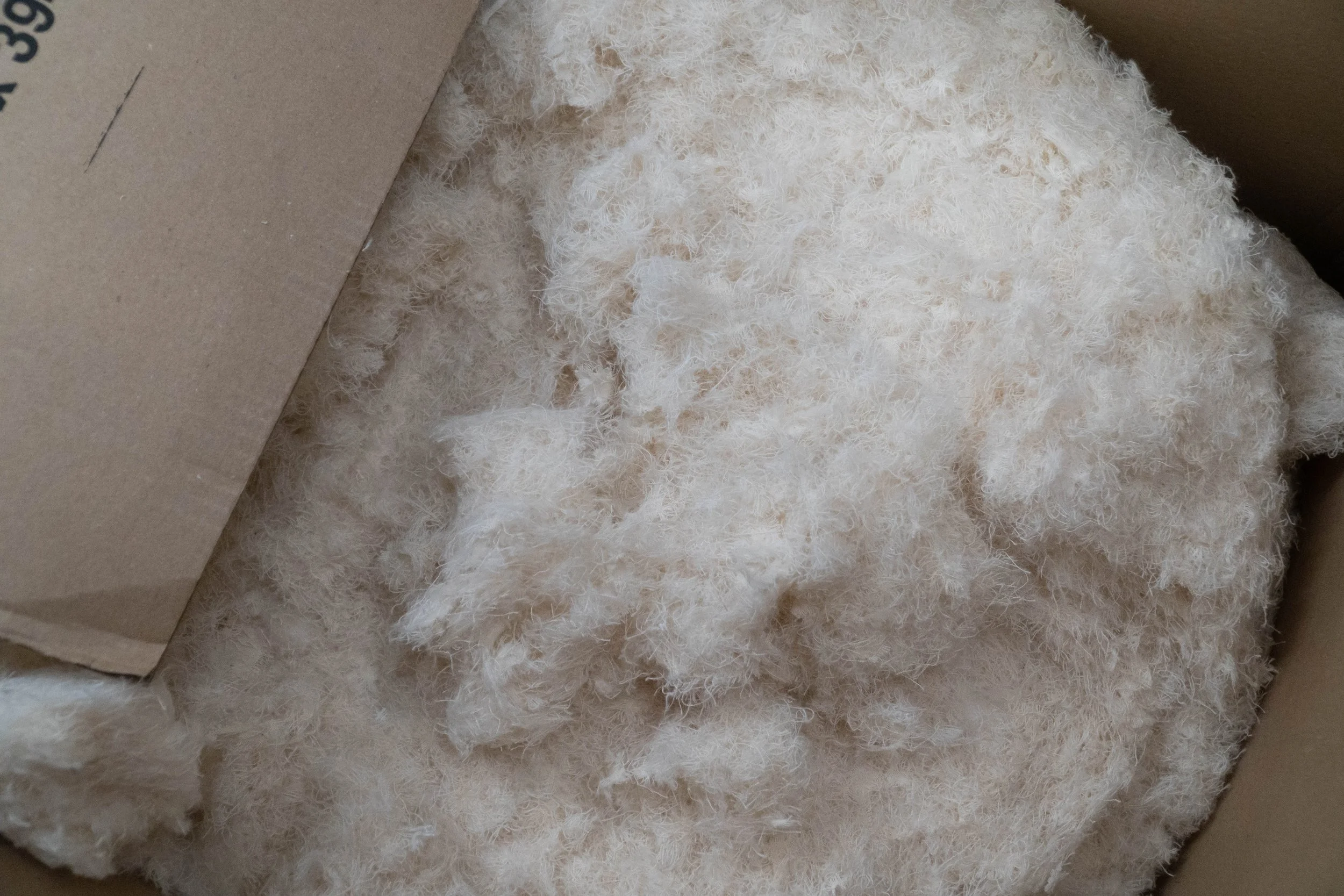
For example, packaging materials are often only needed for a very short period of time. In these cases, materials designed to break down more easily, such as mycelium-based packaging, may be far more appropriate than long-lasting materials like polystyrene that persist in the environment long after their use has ended. Similarly, in applications such as trade shows or temporary installations, designers may prioritise materials that can be deconstructed, stored, and reused rather than discarded after a single event.
At the other end of the spectrum, some materials require significant resources, energy, or craftsmanship to produce. In interior design or architecture, these higher-impact materials may still be appropriate if they are designed to last for many years and are maintained properly throughout their lifespan. In these cases, longevity, care, and repair become key strategies for ensuring that the value of the material is fully realised.
Thinking carefully about lifespan helps designers choose materials that perform effectively during use while avoiding unnecessary waste afterwards.
4. What Is the Material Composition?
Many materials and products are made from multiple materials combined together, often referred to as composites. While these combinations can improve strength, durability, or performance, they can also make materials much harder to recover at the end of their life.
Understanding the composition of a material helps designers determine whether different elements can be separated or recovered later. Adhesives, coatings, and permanently bonded layers can make separation difficult, meaning otherwise valuable materials may end up as waste.
By looking closely at how a material is constructed, whether it is a single material, layered system, or bonded composite, designers can better understand how it might be disassembled, repaired, or processed in the future.
Considering material composition at the specification stage helps avoid unintentionally locking materials into systems that are difficult to separate or recover later.
5. Can It Be Repaired, Reused, or Recycled?
When considering what happens after use, it is important to prioritise repair and reuse before recycling. Extending the life of a material or product often has a much lower environmental impact than breaking it down and processing it again.
Designers can support this by specifying materials and systems that allow for maintenance, repair, and replacement of individual components. Products designed to be reused or adapted over time can remain valuable long after their initial application.
If recycling is the most realistic option, it is important to consider whether suitable systems actually exist. Recycling pathways depend on local infrastructure, specialist recycling facilities, or manufacturer take-back schemes. A material may be technically recyclable, but that does not always mean it will be recycled in practice.
When thinking about biomaterials, it is important to consider what sort of composting systems are needed.
Understanding these real-world recovery systems helps designers make choices that keep materials in circulation for as long as possible.